


Specialist in Training for Teachers of
|
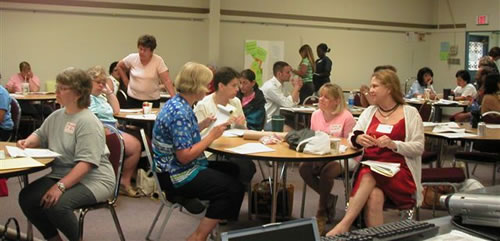
Customized workshops are available to clients who wish to provide training for teachers and or administrators of students in kindergarten through high school. Additional services to school districts are available for other types of consulting including but not limited to the development of gifted student identification procedures and planning curriculum differentiation. Gifted/Talented Foundation Courses (primary, elementary, and secondary) |
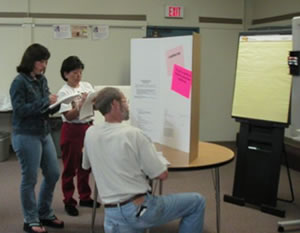 Teachers gathering ideas during an active workshop on The Development of Centers |
A Sampling of Workshops
The Power of Visual-Spatial Thinking in Mathematics
Audience: grades 3-5
Visual-spatial thinking obviously relates to geometry, but it also holds power for those who use it in other forms of mathematics. While some children seem to be talented in the area of visual-spatial intelligence, others, even those gifted in mathematics, need encouragement to realize its potential. This workshop focuses on ways to stimulate visual-spatial thinking and develop talent in mathematics.
Encouraging Advanced Thinking Through Children’s Literature
All students need ample opportunities to use advanced thinking. This workshop delves into children’s literature as a stepping stone for students to think at higher levels while enjoying picture books. Additionally, many of the characters in the selected books are good thinkers and problem solvers and may serve as models for students. Discover how even those students who struggle with content can be given opportunities to exercise advanced thinking. Come prepared to practice strategies and questioning designed to bring out the best in your students. (Please bring a copy of the TEKS for your grade level.)
Thinking Tools for Advanced Academics
This workshop looks beyond the common strategies used in higher order thinking and examines important connections that can be made by applying the tools of Synectics and Lateral Thinking. Both Synectics, which uses different types of analogies, and Lateral Thinking, developed by Edward deBono, help students refine skills of analysis. These are both particularly appropriate for use in idea generation, decision-making and problem solving. Participants will learn how to efficiently introduce the tools to students and consider how to immediately transfer them to specific academic content.
Precocious Writers
Audience: Grades 2-5
Some children seem born to write. They continuously create stories, poems, or other genres while pouring out their innermost thoughts. This workshop emphasizes facilitation of young writers through a discussion of story-writing and illustration styles appropriate for GT elementary students. Specific selections of children’s literature appropriate for writing prompts for writing will be included.
Differentiation of Elementary Social Studies
Audience: grades 1-5
The emphasis of schools during the elementary years is often on math and reading at the expense of social studies and science. This workshop emphasizes the differentiation of social studies curriculum as an avenue for promoting interest in reading for the sake of learning and answering questions. Participants will be involved with literature that emphasizes dominant concepts in social studies and that helps develop generalizations, thus adding depth and complexity. Specific instruction strategies appropriate for social studies will be included.
Shovels and Picks: Advanced Thinking in the Kindergarten Classroom
Explore tools and strategies to encourage young students to dig deeper and climb higher. This workshop demonstrates how to give students something challenging to think about while still immersing them in developmentally appropriate content. Participants will be involved with utilization of the elements of depth and complexity and advanced thinking skills on TEKS-based content.
Developing Outstanding Products and Performances for Elementary
This elementary session emphasizes the need for gifted students to become producers of information rather than consumers. Through a discussion of various types of research, teachers will consider how best to involve their students in the processes necessary to generate qualitatively different products and performances. Participants will create assessments for advanced level products.
District Planning for Gifted Education: Vertical Teams’ Training
As districts plan for gifted education services, they must ensure continuity across grade levels and consistency among schools. This two-day workshop, takes participants through a step-wise process of developing a vertical team, writing a GT scope and sequence, and utilizing this document for classroom curriculum differentiation. Participants leave the training with the information needed to begin or continue the process of curriculum development and with a healthy start on their own district scope and sequence. Please plan to attend this workshop with two or more colleagues from your district.
Best Practices in Gifted Education: A Professional Level Workshop
This scholarly session will provide participants with the opportunity to explore and discuss the latest research in gifted education. Readings and discussion will focus on changing definitions of giftedness and intelligence, new and alternative methods of identification of gifted students, multiple delivery models for gifted services, and recent developments in the areas of G/T curriculum, instruction, and assessment.
Setting the Table for Creative Thinking Skills in Elementary Mathematics
Audience: 1-4
A gifted student may have outstanding mathematical skills, yet not know how to apply them in a creative manner. In this session, participants will consider how to encourage gifted students to think creatively about processes and products for mathematical situations and will work with colleagues to produce ideas appropriate for use in their classrooms. Bring a copy of your mathematics TEKS and be prepared to think outside the box.
Advanced Creative Problem Solving (CPS) in Social Studies and Language Arts
Research indicates that students do not always transfer creative thinking skills learned in class to real life situations. Teachers, therefore, need to help students make realistic connections that enable them to realize the true power of these skills and of the Creative Problem Solving (CPS) Method. Following a brief review of constructs of creative thinking and the CPS method, participants will work on the critical use of these skills within the Social Studies and Language Arts disciplines. Attendees will also consider how to continue student learning by involving GT students in authentic problem solving and creative thinking. Please bring your Language Arts and/or Social Studies textbook.
Thinking Creatively About Primary Science (K-2)
Creative thinking is a necessary component of scientific inquiry and the constructs of creativity correspond with science process skills. This workshop focuses on helping students develop creative thinking through inquiry and experimentation and allows participants to create their own activities for primary students based upon the framework presented. Bring your science TEKS and plan to collaborate with colleagues.
Centers in the Middle School Classroom
Middle School teachers often run short on time when trying to manage appropriate curriculum for varying student levels in each class. This workshop provides hands-on exploration of a possible solution for this dilemma as participants become involved in curriculum centers. Teachers will learn to create their own centers and discover how to manage time in an engaging classroom. Participants should bring a copy of the TEKS to this workshop.
Creativity and Content
While most teachers appreciate the need for creative thinking, it often seems impossible to facilitate in today’s TEKS-driven classroom. Yet, the TEKS provide numerous opportunities to embed creative thinking in curriculum in order to facilitate learning and understanding. Following a brief review of creativity, participants will become involved in developing content lessons that also facilitate the development of creative thinking. Participants should bring a copy of the TEKS to this workshop.
Elementary Literature, the TEKS, and the Gifted Learner
It is often difficult to differentiate for gifted readers with interesting and challenging content. In this workshop, information about gifted readers will be provided; and following close examination of Reading TEKS, participants will discuss appropriate goals and objectives for these students. The presenter will discuss specific classroom management strategies and teaching techniques for working with gifted readers. Participants will need to bring a copy of the Reading TEKS for their grade and are invited to bring literature that they have used successfully with gifted readers.
Scholarly Behavior: Leading Gifted Students In to Advanced Content and Products
(Upper Elementary and Secondary)
As gifted children acquire the attributes of scholars and learn processes used by them, these students delve into the depth and complexity of fields of study. This session will focus on how teachers can facilitate the development of scholars among gifted students. Participants will explore the characteristics of scholars while participating in effective strategies applicable in multiple areas of study. Attendees will also consider how scholarly behavior can lead to the development of advanced products and performances.
The Joy of Convergence in Creative Thinking
There’s life on the other side of creative thinking! Convergent thinking is often neglected in creativity training but is vital to the creative process. This session explores some of the important tools that students may use following idea-generation to help them make decisions. Come to this session; diverge with the group; and yield to the urge to converge!
Honing the Art of Preparing Tiered Assignments
Tiered assignments in which students in a class have different levels of an assignment are an effective way of differentiating for gifted students. It is appropriate for use in a heterogeneous class or with a group of homogeneously grouped gifted students. This workshop focuses on effective strategies for planning tiered assignments included content, process, product modifications, and differentiation continuums. Participants utilize these strategies during the workshop for developing their own tiered assignments that can be used in their classrooms. Participants should bring a copy of their TEKS to the session.
Depth, Complexity, and the TEKS
You may have all the pieces to the gifted and talented curriculum puzzle, but do you wonder how they fit together? Participants will become involved in a discussion of how the TEKS apply to curriculum for gifted and talented students. This session will also facilitate differentiation of the TEKS through elements of depth and complexity providing a framework for lesson development.
Creative Thinking and Problem Solving for Young Learners
Characters in children’s picture books model components of creativity and demonstrate methods for solving problems. This session involves an examination of specific characters and how they can be used to teach students about creative thinking. The workshop will include techniques for bringing out the creativity in students while they learn about its importance. Participants will receive a brief list of books and some activities that emphasize specific creative constructs.
The Development of Differentiated Centers
Centers are a necessary part of the primary classroom and serve as a developmentally appropriate way for students to learn and/or apply new knowledge and skills. Yet students need varying levels of activities within some centers. During this workshop, participants learn about strategies for differentiating typical centers in order to make them more appropriately challenging for gifted or high achieving students. Some center examples will be provided and participants will apply the workshop strategies to their own ideas in order to differentiate current centers.
It’s In the Bag: Divergent Thinking for Young Children
Put divergent thinking activities in a bag to help parents encourage students at home, use them as centers in the classroom, or develop lessons from the ideas. Learn to create your own bags based on the TEKS and important classroom content. Then discover how to organize a lending library for your room or library.


